
If you have ever received a text that says “FYI, the meeting was moved” or “FYI, I already sent it,” you may have wondered what those three letters actually mean. FYI stands for “for your information.” It is one of the most common abbreviations used in texting, email, social media, workplace chats, and online conversations.
People usually use it when they want to give someone information without necessarily asking them to do anything. Depending on the situation, FYI can sound helpful and neutral, but it can also come across as slightly cold, formal, or even passive-aggressive. The meaning is usually simple. The tricky part is understanding the tone behind it.
For example: “FYI, your package arrived.” This is probably just a quick heads-up. “FYI, I already told you about this yesterday.” That can sound annoyed or defensive. So, what does FYI mean in text, and how should you respond when someone uses it? Let’s break it down in a simple way.
What Does FYI Mean in Text?
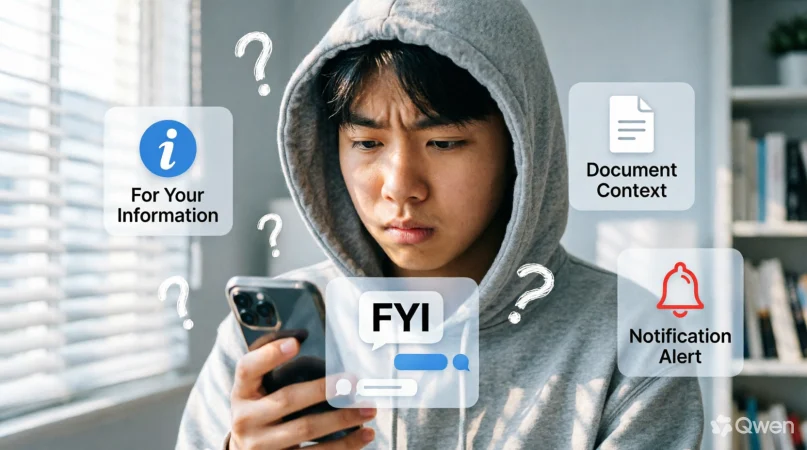
In texting and online communication, FYI means “for your information.”
It is used to introduce information that someone thinks you should know.
For example:
- “FYI, the store closes at 8.”
- “FYI, Sarah won’t be coming tonight.”
- “FYI, I left your keys on the table.”
- “FYI, the deadline has been extended.”
- “FYI, there’s traffic on the main road.”
In each example, the person is mainly giving you an update.
They are not necessarily asking you a question or telling you to take action.
Think of FYI as another way of saying:
“Just so you know…”
or
“I wanted to let you know…”
or
“Here’s some information you might find useful.”
The abbreviation simply makes the message shorter.
What Does FYI Stand For?
FYI stands for:
For Your Information
It is an initialism made from the first letters of the three words:
- F = For
- Y = Your
- I = Information
Although FYI is now extremely common in digital communication, it was not created specifically for texting.
It has been used in written communication for many years, especially in offices and professional environments. As email, instant messaging, and smartphones became part of everyday life, FYI naturally became popular online as well.
Today, you may see it in everything from casual texts to workplace Slack messages and social media conversations.
Is FYI Rude?
FYI is not automatically rude.
Its tone depends heavily on the words around it, the relationship between the people communicating, and the situation.
A friendly message such as:
“FYI, I picked up your favorite snacks 😊”
usually sounds completely harmless.
But consider:
“FYI, I asked you to do this three times.”
That sounds much more confrontational.
The abbreviation itself is neutral. The context creates the tone.
This is important because short written messages do not contain facial expressions, voice tone, or body language. As a result, something that sounds perfectly normal to one person may sound blunt to another.
When FYI Sounds Friendly
FYI can be friendly when someone is simply sharing useful information.
For example:
“FYI, there’s free parking behind the building.”
The person is helping you.
Another example:
“FYI, your appointment is at 3:30 instead of 4.”
Again, there is no obvious negative meaning.
When FYI Sounds Formal
FYI is also common in professional communication.
For example:
“FYI, I’ve attached the updated report.”
This means the sender wants you to be aware of the report.
In a workplace, FYI can make a message concise and efficient.
When FYI Sounds Passive-Aggressive
Sometimes FYI is used to emphasize something the sender believes you should already know.
For example:
“FYI, everyone else finished their part.”
The literal meaning is still “for your information,” but the hidden message might be:
“You need to catch up.”
Another example:
“FYI, I was waiting for you for an hour.”
That could communicate frustration even though the words themselves are not openly aggressive.
This is why you should never judge the meaning of FYI from the abbreviation alone.
FYI Meaning in Chat
In chat, FYI usually works as a quick way to give someone a heads-up.
You might see it in conversations on messaging apps, workplace chat platforms, gaming communities, or social media.
For example:
“FYI, Mike is joining us later.”
Or:
“FYI, the server is down.”
Or:
“FYI, I won’t be online tonight.”
The basic purpose is the same: the sender wants you to know something.
It does not necessarily require a response.
Sometimes the sender may simply be keeping you updated.
FYI Meaning on Social Media
On social media, FYI can be used in both casual and informational posts.
Someone might write:
“FYI, the event starts at 6 PM.”
Or:
“FYI, this offer ends tonight.”
It can also appear in comments:
“FYI, that photo was taken last year.”
In these situations, FYI introduces information that the writer thinks is relevant.
On platforms where people frequently share corrections, updates, announcements, and explanations, FYI can be particularly useful.
However, the tone can vary.
For example:
“FYI, that’s not what happened.”
may sound like a correction or disagreement.
The words that follow FYI are therefore very important.
FYI Meaning on Instagram
On Instagram, people may use FYI in captions, comments, direct messages, or Stories.
For example:
“FYI, new items are available now.”
A friend might also message:
“FYI, I tagged you in the post.”
Or someone could comment:
“FYI, the original creator is credited in the caption.”
In each case, FYI means the person is providing information.
It does not have a special Instagram-only definition.
FYI Meaning on Snapchat
On Snapchat, FYI generally has the same meaning.
Someone might send:
“FYI, we’re meeting at 7.”
Or:
“FYI, I saved the picture.”
Because Snapchat conversations tend to be casual and fast, FYI can simply be a convenient shortcut for “just so you know.”
Again, context determines whether it feels friendly, neutral, or serious.
FYI Meaning on TikTok
TikTok users may use FYI in captions and comments to introduce additional information.
For example:
“FYI, this trend started years ago.”
Or:
“FYI, the recipe uses oat milk.”
It can also be used when correcting or clarifying something:
“FYI, the video was filmed in 2024.”
The meaning remains “for your information.”
There is no separate secret TikTok meaning attached to the abbreviation.
FYI Meaning in Text From a Friend
When a friend texts you “FYI,” it is usually nothing complicated.
For example:
“FYI, Emma is coming with us.”
Your friend is simply giving you an update.
You might reply:
“Thanks for letting me know!”
Or:
“Okay, good to know.”
Or you may not need to reply at all.
If the message contains important information, acknowledging it can be helpful.
FYI Meaning From a Boy or Girl
If someone you are talking to sends you a message beginning with FYI, you should not automatically assume there is a romantic or hidden meaning.
For example:
“FYI, I’ll be busy tomorrow.”
Most likely, they are simply sharing information.
Likewise:
“FYI, I saw your friend at the mall.”
does not automatically contain a secret message.
If you are wondering whether someone is interested in you, look at the whole conversation, not one abbreviation.
FYI by itself does not indicate flirting, attraction, anger, or affection.
What Does “FYI” Mean From a Guy?
If a guy texts you “FYI,” the basic meaning is still “for your information.”
For example:
“FYI, I’m going to the gym after work.”
He is simply giving you information.
The tone may become more meaningful depending on what follows:
“FYI, I really liked talking to you today.”
That is warmer than:
“FYI, don’t forget the appointment.”
But the emotional meaning comes from the sentence, not from FYI itself.
What Does “FYI” Mean From a Girl?
The same principle applies if a girl uses FYI.
For example:
“FYI, your package came.”
This is simply an update.
Or:
“FYI, I won’t be at school tomorrow.”
Again, it is information.
There is no universal difference between how men and women use FYI.
Examples of FYI in Text Messages
Here are some realistic examples to make the meaning clearer.
Example 1: Simple Update
Person A: “Are you still coming tonight?”
Person B: “Yeah. FYI, I’ll be about 20 minutes late.”
Here, FYI introduces useful information.
Example 2: Helpful Information
Person A: “Where should I park?”
Person B: “FYI, the parking lot behind the building is free.”
The sender is helping.
Example 3: Workplace Message
Coworker: “FYI, the meeting has been moved to Friday.”
This is a professional update.
Example 4: Family Conversation
Sibling: “FYI, Mom is coming over this afternoon.”
The person is simply keeping you informed.
Example 5: Possible Frustration
Person A: “Why didn’t you tell me?”
Person B: “FYI, I sent you a message yesterday.”
This can sound defensive because the sender is pointing out that they already provided the information.
Example 6: Social Media Correction
Comment: “FYI, the original video was posted by another creator.”
Here, the person is adding clarification.
Common Phrases With FYI
FYI can appear at the beginning, middle, or sometimes end of a sentence.
Here are some common patterns.
“FYI, …”
This is probably the most common format.
“FYI, the office is closed tomorrow.”
It means:
“Just so you know, the office is closed tomorrow.”
“Just FYI…”
This sounds more conversational.
“Just FYI, I’ll be leaving early.”
It is similar to:
“Just so you’re aware…”
“For your information…”
This is the full form.
“For your information, the meeting starts at 10.”
In everyday texting, most people would simply write “FYI.”
“FYI about…”
Sometimes people use it before a topic.
“FYI about tomorrow’s event: parking is limited.”
This is less common than simply saying:
“FYI, parking is limited tomorrow.”
FYI vs. “Just So You Know”
These two expressions are very similar.
FYI is shorter and more direct.
Just so you know sounds more conversational.
Compare:
“FYI, I’m running late.”
and:
“Just so you know, I’m running late.”
Both mean roughly the same thing.
The second version can feel slightly warmer in casual conversation.
If you are worried that FYI might sound too formal or blunt, “just so you know” is often a good alternative.
FYI vs. BTW
FYI and BTW are sometimes confused because both are common texting abbreviations.
But they serve different purposes.
FYI = For Your Information
BTW = By The Way
FYI usually introduces information that the sender wants you to know.
Example:
“FYI, the deadline is tomorrow.”
BTW often introduces an additional thought or changes the subject slightly.
Example:
“BTW, did you call John?”
A simple way to remember the difference is:
FYI = information
BTW = another point
FYI vs. FWIW
Another abbreviation you may encounter is FWIW, which means “for what it’s worth.”
For example:
“FWIW, I think your idea is good.”
This often introduces an opinion, suggestion, or personal perspective.
FYI is different:
“FYI, the meeting starts at 9.”
That is simply information.
So:
- FYI → information
- FWIW → opinion or perspective
FYI vs. IMO
IMO means “in my opinion.”
Example:
“IMO, the first movie was better.”
That tells you the statement is someone’s opinion.
FYI does not indicate an opinion:
“FYI, the movie starts at 8.”
This is presented as information.
How to Respond to FYI
You usually do not need a complicated response.
Your reply depends on what the person tells you.
If they give you useful information, you can say:
- “Thanks!”
- “Thanks for letting me know.”
- “Good to know.”
- “Got it.”
- “Okay, thanks.”
- “Appreciate the heads-up.”
If the message does not require a response, you may simply leave it there.
For example:
Friend: “FYI, I’ll be home around 9.”
You: “Okay!”
That is enough.
What If FYI Sounds Rude?
If you receive an FYI message that feels rude, try not to assume the sender intended to be disrespectful.
Text messages are easy to misread.
For example:
“FYI, I already sent it.”
could be completely neutral.
The sender may simply be answering your question.
But if the conversation has already been tense, you might interpret it differently.
When the meaning is unclear, consider the larger context:
- What was said before?
- What is your relationship with the person?
- Does the sender normally communicate this way?
- Are they providing information or criticizing you?
- What words come after FYI?
These clues are much more useful than the abbreviation itself.
Is FYI Professional?
Yes. FYI is widely understood in professional communication.
It can be useful in emails, team messages, project updates, and internal notes.
For example:
“FYI, the client approved the revised timeline.”
This is clear and concise.
However, professional communication still benefits from context.
If the message is formal or being sent to someone outside your organization, you may prefer:
“I wanted to let you know that the client approved the revised timeline.”
That sounds more polished.
FYI is generally better suited to situations where the recipient already understands the context.
Can You Use FYI in an Email?
Absolutely.
For example:
“FYI, I’ve attached the updated document.”
This tells the recipient that the document is included for their awareness.
Another example:
“FYI, the schedule has changed slightly.”
It is especially common in workplace emails.
However, FYI can sometimes sound abrupt if the message contains criticism.
For instance:
“FYI, you missed the deadline.”
A more professional approach might be:
“I wanted to let you know that the deadline was missed.”
The second version sounds less confrontational.
Is FYI Formal or Informal?
FYI can be both.
It has a professional history, so it is common in formal environments. At the same time, people use it casually in texts and social media.
Its level of formality depends on the context.
In casual texting:
“FYI, I’m bringing pizza.”
At work:
“FYI, the client meeting has been rescheduled.”
In a formal letter:
The full phrase “for your information” may sound more appropriate.
So FYI is flexible enough for many situations.
Does FYI Mean You Need to Do Something?
Usually, no.
FYI generally means the information is being shared for awareness.
For example:
“FYI, the office will be closed Monday.”
You do not necessarily have to do anything.
If the sender wants you to take action, they may say so directly:
“FYI, the office will be closed Monday, so please submit your paperwork by Friday.”
Here, FYI introduces the information, while the second part explains the action needed.
This distinction can prevent misunderstandings.
Can FYI Be Sarcastic?
Yes.
Like many ordinary expressions, FYI can be used sarcastically.
For example:
“FYI, not everyone has unlimited free time.”
The literal meaning is still “for your information,” but the sentence may be intended as criticism.
Another example:
“FYI, we did discuss this already.”
Depending on the conversation, this could be a gentle reminder or a sarcastic comment.
Again, the tone comes from context.
Why Do People Use FYI So Often?
The biggest reason is convenience.
Typing “for your information” takes longer than typing three letters.
Online communication has encouraged people to shorten common phrases.
FYI is also instantly recognizable to many English speakers.
It allows someone to communicate:
“I want you to know this, but I’m not necessarily asking you anything.”
That is a useful function in fast conversations.
FYI in Group Chats
FYI can be especially useful in group chats because not everyone sees every conversation.
For example:
“FYI, the location has changed to Room 204.”
This quickly updates everyone.
Someone else might write:
“FYI, John won’t be joining us.”
Again, the goal is simply to keep the group informed.
In busy group conversations, short phrases like FYI can make important updates easier to notice.
FYI in Workplace Messaging
Modern workplaces frequently use chat platforms for quick communication.
An employee might write:
“FYI, the presentation has been uploaded.”
Or:
“FYI, the customer requested a different delivery date.”
This is often more efficient than sending a long email.
Still, communication style matters.
If every message starts with FYI, it can eventually feel repetitive or overly formal. In many cases, simply saying:
“The presentation has been uploaded.”
is perfectly clear.
Good communication is not about using abbreviations whenever possible. It is about making the message easy to understand.
Should You Use FYI With Everyone?
Not necessarily.
FYI is widely understood, but different people have different communication preferences.
With close friends, you might naturally say:
“Just so you know…”
With coworkers, FYI may be perfectly normal.
With someone who is not familiar with English abbreviations, writing the full phrase may be clearer.
The best approach is to match the communication style of the person and situation.
How to Tell What Someone Means by FYI
If you want to understand the intended tone, look at five things.
1. The words after FYI
Compare:
“FYI, dinner is at 7.”
with:
“FYI, you forgot to lock the door again.”
The second one is much more likely to carry criticism.
2. Your relationship
A close friend may use FYI casually.
A manager might use it professionally.
A stranger might use it to correct information.
3. The previous messages
Conversation history can completely change how a message sounds.
4. Punctuation
“FYI, thanks!” feels different from:
“FYI. I already told you.”
The second can feel much sharper.
5. The situation
If there is already an argument, even a neutral abbreviation can sound negative.
Frequently Asked Questions About FYI
What does FYI mean in texting?
FYI means “for your information.” It is used to give someone information or an update, often without asking them to take action.
What does FYI mean from a friend?
Usually, it simply means “just so you know.” Your friend is giving you information they think you should be aware of.
Is FYI rude in a text?
Not by itself. FYI is neutral, but the surrounding words and situation can make it sound blunt, annoyed, or passive-aggressive.
Does FYI mean “just so you know”?
Yes. “Just so you know” is one of the closest everyday equivalents to FYI.
What should I reply to FYI?
A simple response such as “Thanks,” “Good to know,” “Got it,” or “Thanks for letting me know” is usually enough.
Is FYI used only at work?
No. Although FYI is common in professional communication, people also use it in texts, group chats, emails, comments, and social media.
What is the difference between FYI and BTW?
FYI means “for your information,” while BTW means “by the way.” FYI focuses on giving information; BTW usually introduces an additional thought.
What is the difference between FYI and FWIW?
FYI means “for your information.” FWIW means “for what it’s worth” and is usually used before an opinion or perspective.
Can FYI be sarcastic?
Yes. The abbreviation itself is neutral, but someone can use it sarcastically depending on their wording and tone.
Final Thoughts
So, what does FYI mean in text? The simple answer is “for your information.” People use it when they want to give you an update, point out something you should know, or share information without necessarily asking you to respond. In casual conversations, FYI can mean: “Just so you know.” At work, it can mean: “I’m sharing this for your awareness.” “You should already know this.” That is why the surrounding conversation matters so much.
If someone texts you “FYI,” there is usually no hidden meaning. Read the rest of the message, consider the situation, and you will usually understand the intended tone. And if you are unsure how to respond, keeping it simple works perfectly well: “Thanks for letting me know.”
Discover more post
What Does X Mean in Text Real Meaning Examples 2026
What Does mg mean in text Mean in Text 2026
what does glm mean in text Mean in Text 2026

Jeorge is a passionate digital content creator and SEO specialist with over 5 years of experience in decoding internet slang, chat abbreviations, and modern texting trends. As the lead author of TextzMeaning.com, he is dedicated to helping readers clearly understand the real meanings behind viral acronyms and social media language. His expertise combines search engine optimization with user-focused writing, ensuring every article is accurate, easy to read, and highly valuable. Jeorge’s mission is simple: make online communication smarter, clearer, and easier for everyone.