If someone sends you a message containing “…””, you might pause and wonder what they are trying to say. Is it sarcasm? Are they upset? Is it a typo? Or does the punctuation have a hidden meaning?
Texting has changed the way people communicate. Instead of using complete sentences, we often rely on emojis, abbreviations, punctuation, and tiny combinations of symbols to express feelings. Sometimes, even three dots can say more than an entire sentence.
The combination “…”” is especially confusing because it does not have one universal definition. Its meaning usually depends on the conversation, the person using it, and the punctuation around it.
In this guide, we’ll explain what …” can mean in text, why people use dots and quotation marks together, how the expression can sound in different conversations, and how to figure out what someone actually means.
What Does …” Mean in Text?
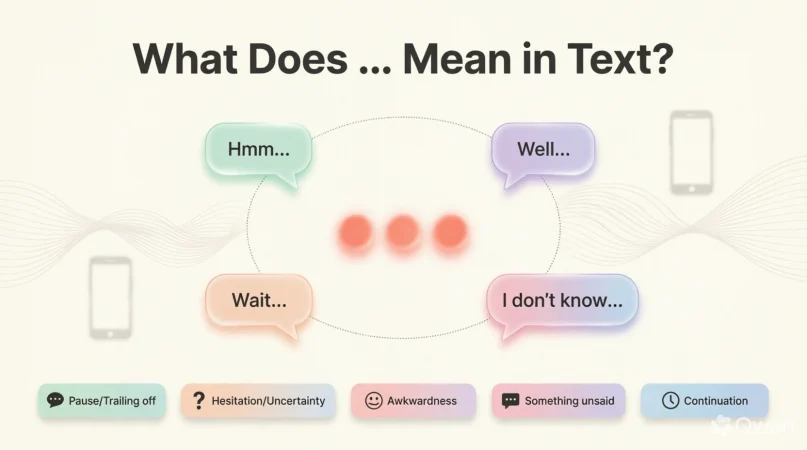
The combination “…”” does not have a fixed dictionary meaning or universally accepted texting definition.
Most of the time, the three dots (…) represent a pause, hesitation, an unfinished thought, awkwardness, silence, or something left unsaid. The two apostrophe-like marks (”) may be used as quotation marks, emphasis, or simply as part of someone’s typing style.
So when you see …” in a text, the meaning is usually determined by context.
For example:
“I thought you were coming…”
This could suggest hesitation, disappointment, uncertainty, or that the person is leaving something unsaid.
Another example:
“Okay…”
Depending on the conversation, this might mean:
- “Okay, I understand.”
- “Okay… if you say so.”
- “I’m not sure about that.”
- “I’m uncomfortable with this.”
- “There’s more I could say, but I won’t.”
That is why you should not automatically assume that …” means someone is angry or annoyed.
What Do the Three Dots (…) Mean in Texting?
To understand the expression, it helps to separate the symbols.
The most important part is usually the ellipsis, written as three dots:
…
An ellipsis indicates that something has been left unfinished or that there is a pause.
In normal writing, an ellipsis can show that a sentence or quotation has been intentionally shortened. In casual texting, however, people often use it to communicate emotion.
Someone might type:
“Well…”
That does not necessarily mean they forgot what they wanted to say.
They could be thinking.
They could be unsure.
They could be uncomfortable.
They might disagree with you but not want to say it directly.
Or they might simply have a habit of using three dots.
Consider these examples:
“I guess…”
This often sounds uncertain.
“Fine…”
This may sound reluctant or annoyed.
“Maybe…”
This can suggest hesitation.
“So…”
This may indicate that the person is waiting for you to respond.
The emotional meaning comes from the surrounding conversation.
Why Do People Use … in Messages?
People use ellipses in texts for many different reasons.
One common reason is to create a pause.
Imagine someone saying:
“I need to tell you something…”
The dots make the reader feel that something important is coming.
Another reason is hesitation.
For example:
“I don’t know if that’s a good idea…”
The writer may be unsure.
Ellipses can also make a message feel softer. Instead of writing:
“No.”
Someone might write:
“No…”
The second version sounds less direct, although it can also sound more emotionally complicated.
Sometimes the dots create suspense:
“You’ll never guess what happened…”
Here, the ellipsis encourages the other person to keep reading or ask what happened.
What Could the ” Mean?
The second part of …” is less standardized.
Two single quotation marks are sometimes used informally in place of quotation marks. Depending on the keyboard, device, or typing habit, a person may use ' instead of ".
For example, someone might write:
He said ”I’m not going.”
Technically, standard English typography would normally use quotation marks differently, but texting is much less strict.
The marks may also be accidental.
A person could have intended to type a quotation mark, apostrophe, or another punctuation mark and simply entered the wrong character.
This is important because not every unusual combination of punctuation is internet slang.
Sometimes …” is simply punctuation.
Is …” a Slang Term?
Generally, **…” is not a standardized slang expression with one agreed-upon definition.
Unlike common texting terms such as “LOL,” “BRB,” or “IDK,” this punctuation combination does not have a universally recognized meaning.
Its interpretation depends heavily on context.
If a friend sends:
“Yeah…”
you cannot know exactly what they mean without considering what happened before that message.
Maybe they are joking.
Maybe they’re annoyed.
Maybe they’re thinking.
Maybe they accidentally added the marks.
This is one reason punctuation in texting can be difficult to interpret.
Does …” Mean Someone Is Angry?
Not necessarily.
This is one of the most common mistakes people make when interpreting punctuation in texts.
Ellipses can sometimes make a message sound annoyed or passive-aggressive, but they can also express uncertainty, sadness, hesitation, surprise, or simply a pause.
Compare these messages:
“Sure.”
“Sure…”
“Sure!!!”
They contain the same basic word, but the punctuation changes the emotional impression.
“Sure.” can sound neutral or firm.
“Sure…” can sound hesitant, reluctant, disappointed, or suspicious.
“Sure!!!” sounds enthusiastic.
Still, punctuation alone cannot prove someone’s emotional state.
If you receive “Okay…” from a friend, don’t immediately assume they are angry. Look at the rest of the conversation.
Does …” Mean Sarcasm?
It can, but there is no guarantee.
People sometimes use ellipses to make sarcastic comments feel more obvious.
For example:
“Wow, that’s a great idea…”
Depending on the context, this could genuinely be positive or could mean the exact opposite.
The reader has to rely on context, previous messages, and knowledge of the person’s usual communication style.
Sarcasm is especially difficult to recognize through text because you cannot hear someone’s voice or see their facial expression.
What Does …” Mean on Social Media?
On social media, punctuation can be even more flexible.
People may use unusual combinations of dots, quotation marks, commas, or other symbols for dramatic effect.
For example:
“You really said that…”
This could communicate disbelief.
“And you thought I wouldn’t notice…”
This might sound teasing or suspicious.
“Okay then…”
This could suggest that the person is ending the conversation, expressing disappointment, or joking.
Social media users also develop personal typing styles. Some people put three dots after almost every sentence. Others use punctuation dramatically to create a certain personality or tone.
Because of that, the same expression can mean different things from different people.
Examples of …” in Text Conversations
Looking at examples is one of the easiest ways to understand how punctuation changes meaning.
Example 1: Hesitation
Person A: Are you coming with us?
Person B: I don’t know…”
Here, the person probably isn’t giving a definite answer. The dots suggest uncertainty or hesitation.
Example 2: Disappointment
Person A: I can’t make it tonight.
Person B: Oh…”
The response could indicate disappointment.
However, the writer might also simply be surprised.
Example 3: Suspicion
Person A: I wasn’t online last night.
Person B: Really…”
The punctuation can make the response sound doubtful.
Example 4: Sarcasm
Person A: I finished the entire project in five minutes.
Person B: Impressive…”
The response could be sincere, but it could also be sarcastic.
Example 5: An Unfinished Thought
Person A: I wanted to tell you something…
The person may be building suspense before continuing.
Example 6: Awkwardness
Person A: So…” are you still talking to him?
The pause can make the question feel uncomfortable or hesitant.
Example 7: Dramatic Effect
Person A: You have no idea what happened next…”
Here, the dots create suspense and encourage the reader to ask for the rest of the story.
The Meaning Depends on the Word Before It
One of the easiest ways to interpret …” is to look at the word immediately before the punctuation.
Consider the word “fine.”
“Fine.”
This could be a simple answer.
“Fine…”
Now it may sound reluctant.
“Fiiine…”
The stretched spelling makes the emotional tone even stronger.
Similarly:
“Okay.”
can sound straightforward.
“Okay…”
can suggest uncertainty or frustration.
And:
“Whatever.”
might sound dismissive.
“Whatever…”
could sound resigned, sarcastic, or emotionally tired.
The punctuation doesn’t completely change the dictionary meaning of the word. Instead, it changes how the reader may hear the sentence mentally.
Why Text Punctuation Can Be Misleading
Text messages remove many communication signals that people normally use.
When talking face-to-face, you can hear someone’s tone.
You can see their facial expression.
You can notice whether they are smiling, joking, or looking upset.
Text doesn’t provide those clues automatically.
As a result, readers often try to interpret punctuation as a substitute for tone.
That’s why a simple message such as:
“Okay.”
can sometimes be interpreted as cold, even when the sender intended it to be completely normal.
Likewise, “…”” might feel mysterious or emotional even when the person didn’t intend anything special.
This is why it’s risky to assign one definite meaning to unusual punctuation.
Is …” a Typing Mistake?
Yes, it can be.
This possibility is easy to overlook.
People type quickly on phones. Autocorrect can interfere. Keyboard layouts can cause accidental characters. Someone may press the wrong key or add punctuation without noticing.
If a person normally writes simple messages and suddenly sends something like:
“I’ll call you later…””
the extra characters may simply be a mistake.
Before interpreting a punctuation combination as slang, consider whether it could be accidental.
How to Tell What Someone Means by …”
If someone sends you a message containing …”, there are several clues you can use.
Look at the Previous Messages
The conversation immediately before the message is usually the biggest clue.
If you were discussing an argument, the punctuation may express frustration.
If you were joking, it may be playful.
If you were discussing an important decision, it could indicate uncertainty.
Look at Their Usual Writing Style
Does the person normally use three dots?
If they do, the punctuation probably doesn’t carry a strong emotional meaning.
Some people naturally type:
“Yeah…”
“Okay…”
“Maybe…”
all the time.
For them, the ellipsis may simply be part of their writing style.
Look at Emojis
Emojis can provide additional clues.
For example:
“Okay… 😂”
probably has a different tone from:
“Okay… 😒”
Likewise:
“Really…?”
has a different emotional feel from:
“Really… 😂”
The symbols surrounding the punctuation can help you understand the intended tone.
Consider the Relationship
A close friend may use unusual punctuation playfully.
A coworker or stranger may be using it more literally.
The relationship between the people involved can change how a message should be interpreted.
What Is the Difference Between … and …”?
The three dots alone have a more recognizable function.
…
Usually indicates a pause, unfinished thought, hesitation, or omitted information.
Adding quotation-style marks afterward:
…”
does not create a completely new universal slang meaning.
The extra marks may indicate quotation formatting, emphasis, personal typing style, or an accidental character.
So if you’re wondering whether …” has a special hidden definition, the safest answer is: not by itself.
The context matters much more than the symbols.
What Does “…” Mean at the End of a Text?
When three dots appear at the end of a message, they often leave the thought open.
For example:
“I thought you knew…”
This sounds like the speaker believes there is something more to the situation.
Another example:
“Maybe we should talk about it later…”
This could simply mean the person doesn’t want to continue the discussion right now.
Sometimes an ellipsis makes a message sound emotional.
“I really trusted you…”
That sentence can feel sad or disappointed because the dots create a sense that the speaker has more to say.
But again, tone depends on context.
What Does It Mean When Someone Uses “…” Instead of a Period?
This is a common texting question.
A period generally marks the end of a sentence.
An ellipsis suggests a pause or something unfinished.
Compare:
“I don’t think so.”
with:
“I don’t think so…”
The first sounds complete and final.
The second sounds more open-ended.
The sender may be hesitant, disappointed, thoughtful, or simply trying to soften the statement.
However, some people use ellipses casually without intending any emotional message.
Does Punctuation Have Different Meanings for Different Generations?
Yes, communication habits can vary by age group, culture, online community, and personal style.
Someone who learned formal writing first may use punctuation differently from someone who grew up communicating mainly through social media and messaging apps.
Even among people of the same age, habits vary.
One person might see:
“Okay.”
as perfectly normal.
Another might interpret it as cold or annoyed.
The same applies to ellipses.
Therefore, there isn’t always one correct emotional interpretation.
Common Misunderstandings About …”
There are a few myths worth clearing up.
Myth 1: It Always Means Anger
False.
It can indicate annoyance, but it can also show hesitation, uncertainty, sadness, suspense, or nothing special at all.
Myth 2: It Is an Official Texting Abbreviation
Not really.
It isn’t comparable to established abbreviations such as LOL or OMG.
Myth 3: It Always Means Sarcasm
No.
Sarcasm is possible, but context determines whether the message is sarcastic.
Myth 4: The Sender Is Definitely Hiding Something
Not necessarily.
An ellipsis can make a message feel mysterious, but that doesn’t mean the sender has a secret.
Myth 5: Everyone Uses It the Same Way
Definitely not.
Typing habits are personal.
How to Respond When You Don’t Understand the Tone
If you’re unsure what someone means, the best solution is often surprisingly simple: ask.
You could say:
“What do you mean?”
or:
“Are you okay?”
or:
“I can’t tell if you’re joking 😂.”
There’s no need to spend ten minutes trying to decode three dots.
Clear communication is usually better than guessing.
This is especially important during disagreements. Assuming that …” means anger could turn a harmless conversation into an unnecessary argument.
Why Context Matters More Than Punctuation
Imagine receiving this message:
“You did that…””
Without context, it’s impossible to know exactly what it means.
Maybe the person is joking.
Maybe they’re impressed.
Maybe they’re angry.
Maybe they’re surprised.
Maybe they are asking for an explanation.
Now imagine the previous message was:
“I accidentally ate the last slice of pizza.”
Suddenly, the meaning could be playful.
If the previous conversation was about a serious disagreement, the exact same punctuation could feel much more confrontational.
The symbols stayed the same.
The context changed.
That’s the key to understanding texting language.
Other Ways People Use Ellipses Online
Ellipses are not limited to conversations.
You may see them in comments, captions, memes, direct messages, and online discussions.
People often use them to:
- Create suspense
- Leave a sentence unfinished
- Suggest disbelief
- Show hesitation
- Build dramatic tension
- Make a statement sound softer
- Imply that there is more to the story
- Reproduce the feeling of spoken pauses
For example:
“And then she said…”
The reader naturally expects more.
Or:
“Well… that’s interesting.”
The dots create a pause before the opinion.
Should You Use …” in Your Own Texts?
You can, but use it carefully.
If you want to avoid misunderstandings, straightforward punctuation is usually easier.
For example, instead of:
“Sure…”
you could say:
“Sure, no problem.”
if you genuinely mean you’re happy to help.
If you are joking, an emoji can sometimes make your tone clearer:
“Sure 😂”
There is nothing wrong with using ellipses, but remember that different people interpret them differently.
Frequently Asked Questions
What does …” mean in a text message?
It usually does not have one fixed meaning. The three dots can suggest hesitation, a pause, an unfinished thought, suspense, or emotion. The quotation-style marks may be punctuation, emphasis, typing style, or an accidental addition.
Is …” a form of texting slang?
Not in the same way as common abbreviations such as LOL or IDK. It is better understood as a punctuation combination whose meaning depends on context.
Does …” mean someone is annoyed?
It can make a message sound annoyed or passive-aggressive, but it does not automatically mean the sender is upset.
Can …” be sarcastic?
Yes. People sometimes use ellipses to create a sarcastic tone. However, you need to consider the words and conversation around it.
Why would someone put three dots after a sentence?
They may be showing a pause, hesitation, suspense, uncertainty, or an unfinished thought. Some people also use three dots simply because they like the way they look.
Does … mean something different from a period?
Usually, yes. A period normally signals a completed thought, while an ellipsis can suggest a pause or an incomplete thought.
Is the ” part important?
Not necessarily. Two apostrophe-like marks don’t have a universal texting meaning when attached to an ellipsis. They may be quotation marks, formatting, personal style, or a typo.
Should I worry if someone texts me …”?
Usually, no. Don’t assume the worst from punctuation alone. Look at the rest of the conversation and the person’s normal communication style.
Final Thoughts
So, what does …” mean in a text? The short answer is that it doesn’t have one universal meaning. The three dots usually create a pause, suggest hesitation, leave a thought unfinished, or add emotional or dramatic tone. The extra quotation-style marks may simply be punctuation or a typing habit.
The real meaning comes from the context, wording, relationship, and communication style of the person sending the message. If someone writes “Okay…””, don’t immediately assume they’re angry. They could be uncertain, joking, disappointed, surprised, or simply typing the way they normally do.
Texting is full of small details that can change how a sentence feels. Punctuation is one of them. When you’re unsure, the best approach isn’t to guess based on one symbol. Look at the whole conversation or simply ask the person what they mean. That’s often the clearest way to understand what someone is really trying to say.
Discover more post
What Does YWA Mean in Text Slang Mean in Text 2026
FYI in text Real Meaning Examples 2026
What Does SBC Mean in Text Real Meaning Use 2026

Clinton is a seasoned SEO content strategist with over 8 years of experience in digital publishing and search optimization. As the lead author at TextzMeaning.com, he specializes in decoding internet slang, text abbreviations, and modern chat language into clear, user-friendly explanations. His work blends data-driven SEO strategies with engaging, easy-to-read content that ranks well and delivers real value. Clinton is passionate about helping readers stay updated with evolving digital communication trends while ensuring every article meets Google’s latest quality standards.