If you received a message containing “LMR” and had no idea what the person meant, you’re not alone. Texting slang can be confusing because the same three letters can mean different things depending on the conversation, the platform, and even the relationship between the people talking.
In most casual texting and social media conversations, LMR commonly means “Like My Recent.” It is usually used when someone wants you to like their latest social media post, photo, video, or other recent content. For example, someone might send: “lmr pls 🙏” They are most likely asking you to like their recent post.
However, that is not the only possible meaning. LMR can have other interpretations in different situations, so it is important to look at the surrounding message before assuming what it means.
This guide explains what LMR means in text, how people use it on social media, what it means on Snapchat, Instagram, TikTok, and other platforms, and how you can respond naturally when someone sends it to you.
What Does LMR Mean in Text?
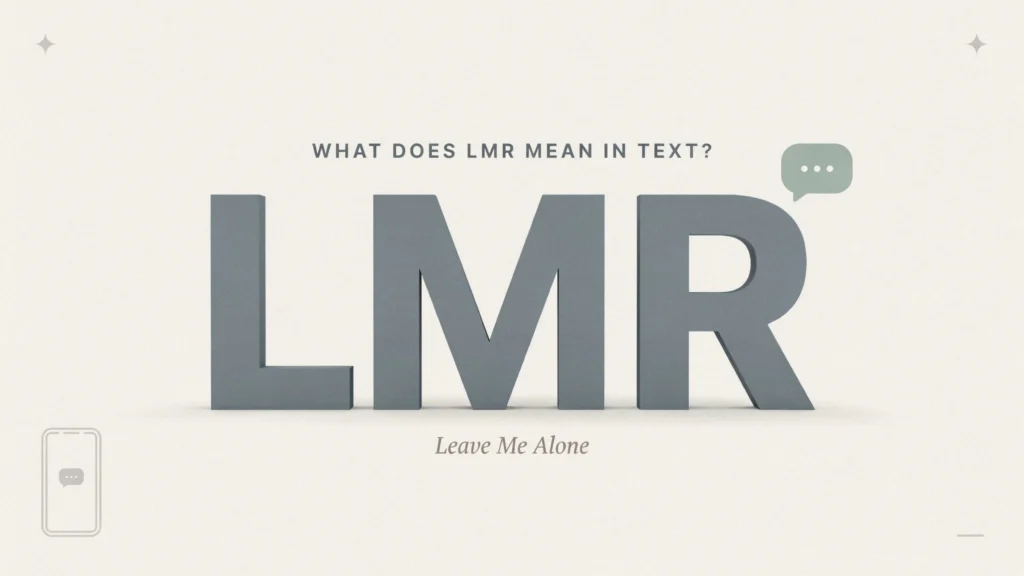
The most common meaning of LMR in text is “Like My Recent.”
It is a short way of asking someone to interact with their newest social media post.
Think of it as a quick request:
LMR = Like My Recent [Post]
The word “recent” usually refers to the person’s latest upload. They may have posted a picture, video, status, Reel, TikTok, or another type of content.
For example:
- “lmr”
- “LMR please”
- “Can you lmr?”
- “lmr on my new pic”
- “Everybody lmr 🙏”
- “lmr when you get a chance”
All of these generally mean that the person wants you to like their most recent post.
Because texting is all about speed, people often leave out the rest of the sentence. Instead of writing “Can you please like my recent post?”, they simply write “LMR.”
What Does “Like My Recent” Mean?
“Like my recent” is social media shorthand.
Suppose your friend just uploaded a new Instagram picture. They want more likes, so they message you:
“lmr ❤️”
They’re essentially saying:
“Please go to my profile and like my latest post.”
The phrase became popular because social media users often communicate through short abbreviations. Rather than explaining which post they mean, they use “recent” because the latest upload is usually easy to identify.
It can also be used when someone is trying to increase engagement on their account.
For example, a person might ask several friends to like their newest post shortly after uploading it. They may use LMR as a quick reminder.
Why Do People Say LMR?
There are several reasons someone might ask you to like their recent post.
1. They want more likes
The simplest explanation is that they want more engagement.
If someone has just uploaded a photo or video, they may want friends to support it by liking the post.
For example:
Friend: “lmr when you see it”
This probably means:
“Please like my newest post when you see it.”
2. They want friends to support their content
Sometimes LMR isn’t about popularity at all.
A friend might have posted something they’re proud of and simply want you to show support.
For example, if your friend uploads a graduation picture, artwork, business announcement, or travel photo, they may ask you to like it.
In that situation, the request is basically a digital version of saying:
“Check out my new post and show me some support.”
3. They are trying to increase engagement
People who regularly post on Instagram, TikTok, Facebook, or other platforms may care about engagement.
Likes can make a post feel more successful, and some creators may ask friends to interact with new content soon after it is published.
That’s why you may see messages such as:
“lmr”
or
“lmr guys”
after someone uploads something.
4. They want you to notice a new post
Sometimes the person simply wants to make sure you don’t miss their latest upload.
You may not have seen it naturally in your feed, so they send you a quick message.
In this case, LMR is almost like saying:
“Hey, I posted something new. Go check it out.”
LMR Meaning on Instagram
On Instagram, LMR usually means “Like My Recent.”
This is probably one of the most common places where you’ll encounter the abbreviation.
Imagine your friend posts a new selfie. A few minutes later, they send you:
“lmr”
You can interpret it as:
“Like my latest Instagram post.”
You might also see variations such as:
- “lmr pls”
- “lmr ❤️”
- “lmr bestie”
- “lmr on my recent”
- “go lmr”
- “lmr guys”
The meaning remains essentially the same.
The person is directing you toward their newest post and asking for a like.
LMR Meaning on Snapchat
The meaning can be a little less obvious on Snapchat because Snapchat isn’t primarily organized around a traditional public feed of posts in the same way as Instagram.
Still, if someone uses LMR while talking about their social media content, they may be using it in the same general sense: “Like My Recent.”
The exact meaning depends on what they are referring to.
For instance, if they have content posted elsewhere and message you on Snapchat saying:
“lmr”
they may expect you to check their recent Instagram or TikTok upload.
If there is no social media context, you shouldn’t automatically assume LMR means “Like My Recent.”
Look at the conversation first.
LMR Meaning on TikTok
On TikTok, LMR can also mean “Like My Recent.”
Someone might post a new TikTok and then message friends:
“lmr on my new vid”
Here, the meaning is especially clear.
They’re asking you to like their latest video.
You might also see:
“lmr guys”
or
“everyone lmr”
after a new video is uploaded.
The abbreviation saves time and is easy to understand among people who are already familiar with social media slang.
LMR on Facebook
The phrase can also appear on Facebook, especially among younger users or people who frequently use internet abbreviations.
For example:
“lmr on fb”
could mean:
“Like my recent Facebook post.”
Facebook has many different types of content, so the “recent” could be a photo, status, video, Reel, or another post.
Again, the surrounding conversation helps clarify exactly what the person wants you to like.
Is LMR Always a Request?
Not necessarily.
Most of the time, when LMR appears in casual social media conversations, it is a request for engagement. But abbreviations can have different meanings.
This is why context matters.
For example:
“Can you lmr?”
strongly suggests “Like My Recent.”
But:
“The LMR was updated yesterday.”
doesn’t sound like a social media request at all. In a professional or technical conversation, LMR could refer to something completely different.
Acronyms are used in many industries and communities. The same three letters can mean one thing in a text message and something entirely different in a workplace, school, gaming, medical, or technical context.
Other Possible Meanings of LMR
Although “Like My Recent” is a common texting interpretation, LMR can stand for other phrases.
Some possible meanings include terms used in business, technology, organizations, or specialized communities.
That doesn’t mean those meanings are likely when your friend sends you “LMR.”
The key is context.
If you’re chatting with a friend about Instagram and they say “LMR,” “Like My Recent” makes obvious sense.
If you’re reading a technical document containing “LMR,” a different definition may apply.
So don’t treat every acronym as having one universal definition.
How to Tell Which Meaning Someone Intended
If you’re unsure what LMR means, look at three things.
Look at the conversation
What were you talking about immediately before the person used LMR?
If the conversation was about Instagram, photos, videos, or social media, “Like My Recent” is a strong possibility.
Look at the platform
Where did they send the message?
If someone messages you on Instagram after posting a new photo, the intended meaning is fairly easy to understand.
If you’re talking through a professional platform or discussing a technical subject, another meaning may be more appropriate.
Look at the words around LMR
The surrounding words often give you the answer.
For example:
“lmr pls”
is likely a social media request.
“lmr on my new post”
makes the meaning almost certain.
But something like:
“LMR project”
may refer to something entirely different.
Examples of LMR in Text Messages
Here are some realistic examples to make the meaning clearer.
Example 1: Asking a friend to like a photo
Alex: “just posted a new pic”
Sam: “nice”
Alex: “lmr pls”
Here, Alex is asking Sam to like the new picture.
Example 2: Supporting a friend’s post
Mia: “I finally uploaded my graduation pics!”
Sara: “omg send me”
Mia: “it’s on my profile, lmr ❤️”
Mia wants Sara to visit her profile and like the recent post.
Example 3: Asking multiple friends
“Guys lmr when you get a chance”
This means:
“Everyone, please like my recent post when you have a chance.”
Example 4: A short DM
“lmr 🙏”
This is an extremely abbreviated request.
The person expects you to understand that they want you to like their latest post.
Example 5: Asking after uploading a video
“new vid up, lmr”
This means:
“I uploaded a new video. Please like it.”
How Should You Respond to LMR?
Your response depends on whether you want to interact with the person’s post.
If you are happy to do it, you don’t need a complicated reply.
You could simply say:
- “Sure!”
- “Done ❤️”
- “Got you”
- “Ofc!”
- “Just liked it”
- “Doneee 😂”
- “I got you!”
If you haven’t seen the post yet, you could say:
“Sure, I’ll check it out.”
Or:
“I’ll look now.”
If you’re not interested, you can simply leave the message unanswered or respond politely.
There is no special response required for LMR.
Is LMR Rude?
Usually, no.
LMR is generally casual and informal. Whether it feels rude depends on the person, the relationship, and how frequently they ask.
For example:
“lmr pls ❤️”
from a close friend is probably harmless.
But if someone repeatedly sends:
“LMR”
“LMR”
“LMR”
every time they post something, it might start to feel pushy or annoying.
The abbreviation itself isn’t rude. The way someone uses it can affect how the message feels.
Is LMR Flirty?
Usually, no.
LMR generally has nothing inherently romantic or sexual about it.
If someone sends you “LMR”, don’t assume they’re flirting. In most social media contexts, they’re simply asking you to like their latest post.
However, context can always change the tone.
For example, if someone you’re interested in sends you LMR and starts chatting with you afterward, there could be a broader social or flirtatious interaction happening. But the abbreviation itself doesn’t mean flirting.
LMR vs. Like for Like
You may also encounter another social media phrase: L4L, meaning “Like for Like.”
These expressions are related but aren’t exactly the same.
LMR means:
“Like My Recent.”
L4L means:
“I’ll like your content if you like mine.”
For example:
“lmr”
is simply a request to like someone’s latest post.
But:
“L4L?”
usually suggests an exchange.
You like my post, and I will like yours.
This distinction can be useful when you’re trying to understand social media slang.
LMR vs. LB
Another abbreviation you may see is LB, which can mean “Like Back.”
For example:
“lb?”
usually means:
“Will you like my post back?”
The person may have already liked your content and wants you to return the favor.
Meanwhile:
LMR = Like My Recent
These abbreviations can appear together in social media conversations, especially among people focused on getting more engagement.
Why Social Media Slang Uses So Many Shortcuts
Internet language changes quickly.
People communicate through short messages, comments, DMs, captions, and notifications. Because of that, users often shorten common phrases.
Instead of writing:
“Please go to my profile and like the newest post I uploaded.”
someone can write:
“lmr pls.”
That’s much faster.
This kind of shorthand isn’t necessarily about being lazy. It’s part of how online communication has developed.
Similar examples include:
- LOL — Laughing out loud
- BRB — Be right back
- BTW — By the way
- IDK — I don’t know
- IMO — In my opinion
- TBH — To be honest
- FYI — For your information
- DM — Direct message
LMR fits into the same general culture of fast, informal communication.
Why People Use Lowercase “lmr”
You may notice people write “lmr” instead of “LMR.”
Both usually mean the same thing.
Texting doesn’t have strict capitalization rules, so users often type abbreviations in lowercase.
For example:
“lmr”
and
“LMR”
generally communicate the same message.
The lowercase version can feel more casual and natural in a DM.
Does LMR Have a Different Meaning in Dating?
Not by itself.
If you see LMR in a dating conversation, the surrounding context becomes especially important.
Someone might say:
“lmr on insta”
which clearly refers to social media engagement.
But if the conversation doesn’t involve social media, you shouldn’t automatically assume the abbreviation means “Like My Recent.”
When an acronym seems confusing, the easiest solution is often to ask:
“What do you mean by LMR?”
There is nothing embarrassing about asking.
Internet slang changes so quickly that even frequent social media users don’t know every abbreviation.
What Does LMR Mean From a Girl?
If a girl sends you “LMR,” it usually means the same thing it means from anyone else:
“Like My Recent.”
It doesn’t automatically carry a hidden romantic meaning.
She may have uploaded a new photo, video, or post and wants you to interact with it.
For example:
“lmr pls 😂”
could simply mean that she wants your support.
Don’t read too much into the abbreviation itself. Pay attention to the rest of the conversation and the relationship between you.
What Does LMR Mean From a Guy?
Likewise, if a guy sends you LMR, he is usually asking you to like his latest social media content.
For example:
“bro lmr”
could simply mean:
“Bro, like my recent post.”
The word “bro” doesn’t change the meaning of LMR.
Is LMR Still Used?
Yes, you may still encounter LMR in casual online conversations, particularly where people ask friends or followers to engage with recent social media content.
However, internet slang isn’t static.
Different age groups, communities, countries, and platforms develop their own expressions. Some abbreviations become less popular while others suddenly become common.
That means the meaning of LMR can depend heavily on where you encountered it.
If you’re writing for a broad audience, it’s better to explain the phrase rather than assume every reader knows it.
Common LMR Variations
People don’t always write the abbreviation in exactly the same way.
You may see:
LMR
lmr
Lmr
lmr pls
LMR please
lmr guys
lmr ❤️
go lmr
lmr on my recent
lmr on my new post
These generally communicate the same basic idea.
The added words simply make the request more specific or friendly.
When You Shouldn’t Assume LMR Means “Like My Recent”
There are situations where “Like My Recent” may not make sense.
Imagine you’re reading a message about:
- a company
- a technical project
- a school assignment
- a medical topic
- a research paper
- a professional organization
- software
- a game
- a product
In those situations, LMR could be an acronym for something specific to that field.
That’s why dictionary-style definitions aren’t always enough for internet slang.
Context is the key.
If you see LMR in a casual social media message, “Like My Recent” is a sensible first interpretation.
If it appears in a completely different setting, investigate the surrounding language before deciding what it means.
Frequently Asked Questions About LMR
What does LMR mean in texting?
In casual texting and social media conversations, LMR most commonly means “Like My Recent.” It is usually a request to like someone’s newest social media post.
What does LMR mean on Instagram?
On Instagram, LMR generally means “Like My Recent.” The person is asking you to like their latest post, photo, Reel, or other recent content.
What does LMR mean on Snapchat?
LMR can still mean “Like My Recent” when someone is referring to social media content, although the exact meaning depends on the conversation.
What does LMR mean on TikTok?
On TikTok, LMR can mean “Like My Recent,” usually referring to someone’s latest video or post.
Does LMR mean like my recent post?
Yes. In the most common social media use, LMR is short for “Like My Recent,” with the missing word “post” understood from context.
Is LMR the same as L4L?
No. LMR means “Like My Recent,” while L4L generally means “Like for Like,” which suggests exchanging likes.
Is LMR a romantic abbreviation?
Usually not. LMR generally refers to social media engagement rather than romance or flirting.
How do I respond when someone says LMR?
If you want to support them, you can reply with something simple such as “Done!”, “Got you!”, or “Just liked it.”
Can LMR have other meanings?
Yes. Acronyms can have different meanings in professional, technical, or specialized contexts. The social media meaning is only one possible interpretation.
Final Thoughts
So, what does LMR mean in text? In most casual social media conversations, LMR means “Like My Recent.” When someone sends you LMR, they’re usually asking you to visit their profile and like their newest post.
You might see it on Instagram, TikTok, Snapchat, Facebook, or in a regular text conversation about social media. The abbreviation is simple once you know it, but remember that context matters. If LMR appears in a technical or professional conversation, it could have an entirely different meaning.
The easiest way to understand internet slang is to look at the words around it, consider the platform you’re using, and think about what the conversation is actually about. And if a friend simply messages “lmr” after uploading a new photo, there’s a good chance they’re saying one thing: Go check out my recent post and give it a like.
Discover more post
what does glm mean in text Mean in Text 2026
What Does YWA Mean in Text Slang Mean in Text 2026
FYI in text Real Meaning Examples 2026

Jeorge is a passionate digital content creator and SEO specialist with over 5 years of experience in decoding internet slang, chat abbreviations, and modern texting trends. As the lead author of TextzMeaning.com, he is dedicated to helping readers clearly understand the real meanings behind viral acronyms and social media language. His expertise combines search engine optimization with user-focused writing, ensuring every article is accurate, easy to read, and highly valuable. Jeorge’s mission is simple: make online communication smarter, clearer, and easier for everyone.